En el viaje que realiza Kurt Schindler por Cantabria1, Asturias, Ávila, Zamora, Cáceres, Badajoz, Salamanca, Toledo y Miranda do Douro, se acompaña de una grabadora portátil de la marca Fairchild Aerial Company, fabricada exprofeso y cedida por la Universidad de Columbia. El resultado de las grabaciones se plasma en unos discos de aluminio de veinte centímetros de diámetro y de reproducción extremadamente inestable, como se detallará más adelante. En este formato, denominado de grabación inmediata, se impresionaron directamente los contenidos que fueron recogidos entre julio de 1932 y enero de 1933.
La documentación inédita hallada en el Centro Documental de la Memoria Histórica señala la presencia de Eduardo Martínez Torner, Ramón Menéndez Pidal3 y Federico de Onís desde el comienzo de la investigación, así como la máquina de grabación inmediata que les acompañó a todos los lugares en los que recogieron canciones, romances, recitados o música instrumental.
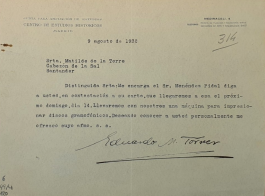
Es necesario señalar que dichas localizaciones son el resultado de trabajos previos de investigación y recogida etnomusicológica por parte, principalmente, de Eduardo Martínez Torner, tal y como se puede comprobar en la colección de partituras que se conserva en la Biblioteca Tomás Navarro Tomás, en años anteriores a las sesiones de grabación que nos ocupan. De igual modo, la consulta de diversos archivos nacionales y extranjeros ha contribuido a poder realizar un análisis más en profundidad de los registros sonoros.
La grabadora y los discos fueron depositados en el Centro de Estudios Históricos y se sumaron a los fondos del mismo, constituyendo un patrimonio sonoro de cerca de mil quinientos discos grabados en los primeros años de la década de 1930. Actualmente, los discos metálicos realizados en 1932 y 1933 por Kurt Schindler, así como la grabadora, se conservan y custodian en los fondos de la Biblioteca Tomás Navarro Tomás del Consejo Superior de Investigaciones Científicas (CSIC). En las grabaciones que realiza Schindler entre España y Portugal hay un total de 985 registros4, de los cuales 4735 pertenecen a registros realizados en territorio nacional. Antes de iniciar el viaje de regreso a Estados Unidos —donde estaba afincado desde 19056—, deposita las grabaciones en el Centro de Estudios Históricos, llevándose una copia consigo. Así lo hace constar en el documento de entrega conservado en la Biblioteca Tomás Navarro Tomás: «Entrega de 160 discos por Kurt Schindler»7, aunque en la actualidad se conservan 145. A su vuelta a los Estados Unidos se lleva otra colección de discos y las notas de sus viajes, que deposita igualmente en la Casa Hispánica de Columbia8. Las transcripciones que se publicaron en la obra póstuma de Schindler revelan que recogió un número mayor de los que estarían documentados y se señalan en el informe musicológico. Existen, asimismo, varias filmaciones datadas en 1932, realizadas por el Centro de Estudios Históricos y digitalizadas en la Biblioteca Tomás Navarro Tomás, que contienen material gráfico documental estrechamente relacionado con las grabaciones que estamos tratando.
En el transcurso de las investigaciones en relación a los discos físicos de la colección Kurt Schindler se constata la existencia de discos de prueba con contenidos y grabaciones en las cajas AS 173 y AS 174, así como numerosos discos sin impresionar. En la gran mayoría de estos registros no se identifica el contenido en la etiqueta, y no encontramos apenas información en los sobres que aclare el contenido, lo que ha supuesto un arduo trabajo cuyos resultados han sido muy fructíferos. En la mayoría de los discos se escuchan recitados, conferencias, jotas u obras zarzuelísticas; no todos en un estado óptimo para su reproducción, aunque sí aquellos en los que se graba exclusivamente la voz.
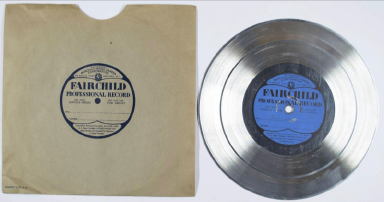
Disco de prueba, 9 de junio de 1932. CCHS-CSIC.
Estos discos de prueba revelan también varios registros sonoros realizados por el equipo responsable del desarrollo del proyecto: el profesor Federico de Onís, así como los dos ingenieros: Albrecht y Ryan, «speaking from the Fairchild Aerial Camera Corporations Recording Instrument Division, 38th Street in New York City9», así como las propiedades y usos para los que han creado la máquina Fairchild, incluyendo además, la fecha de grabación, de junio de 1932. El equipo diseñado y construido para este trabajo fue empaquetado para llegar en las condiciones adecuadas a España y que pudieran así grabarse todos los trabajos que se habrían de realizar. A continuación, transcribimos los registros grabados en dos de los discos de prueba por el equipo de la Universidad de Columbia.
Disco Caja AS 174. Disco 8. Cara A: Profesor Federico de Onís.
Greetings, Professor De Onís. This is Mr. R.L. Albrecht speaking from the Fairchild Aerial Camera Corporation Recording Instrument Division at 38 Street in New York City. I have had the responsibility of producing for you, your portable recording instrument, and I have firmly had in mind the fact that you will be over in Spain and that the instrument must be absolutely perfect and complete in operation, must be free from faults of any kind and must make these recordings of the folk songs that you intend recording with true fidelity. With that thought in mind and feeling a great deal of personal responsibility for your having the type of equipment that you need, we have progressed along those lines, and we are certain that this instrument is the most efficient and best of its kind obtainable today. And I’m sure that it will certainly function to the best advantage of anything of its type required for your work. And uh we are making this test on June the 9th and will place the equipment on the boat tomorrow which was the first steamer leaving here for the port at which you wish to pick up the equipment. So I will close now wishing you a great deal of luck in your undertaking, and look forward to seeing this very complete file of folk songs which you will bring back with you.
Disco Caja AS 174. Disco 8. Cara B: Ingeniero.
Professor de Onís, we are making this recording on the instrument that will packed today to be shipped to you in Spain. You know, this is quite an adventure, and we wish we were to be with you while these recordings are to be made. You know, it is really an adventure, and it’s about the first time anything like this has ever been attempted. Of course, we had sound on film in rural districts and in provincial district. But that is very expensive and calls for a tremendous amount of technical equipment and a technical force. It’s been too expensive for uh the customary research work are for gathering of uh records of uh native dialects [se refiere a que es muy costoso para grabaciones de campo]. They were never important enough to justify moving a large sound recording outfit from place to place.
This instrument makes it available for anyone to make these records to gather a lot of very valuable information on dialects and folk songs. It’s within the reach of [affordable for] practically everyone. And also, this instrument is just about the first or second one that has ever been built for this purpose. We think we have done an excellent job. Mr. Albrecht and Mr. Ryan who built the instrument —designed and built it— are here, and I’m sure they would like to say just a word to you about it… I think it’s the best instrument that we have ever turned out of this department uh for recording the quality of human voice. It is more natural than anything I’ve ever heard on uh any recording instrument. Now Mr. Albrecht wants to say something to you. These men have worked very hard on this and they are proud of what they have done and I think that they are well entitled to feel that way.
And I wish you the best of luck over there this summer and I hope you’re going to bring back a lot of valuable records that will uh… and it will be possible for us to send these records out to a great many places, other schools, even down…
Caja AS 174. Disco 11. Cara A: Ingenieros. 1 de junio de 1932.
This is C.H. Ryan making your test record on June the 9th, 1932 on the portable recording instrument designed for and built rather for Professor De Onís and uh this technical description of the F- [podría corresponder al nombre de la unidad] lineup may be of some value.
The amplifier as well as the motor is a battery operated affair which using 2-volt filament tubes uh. The numbers of these tubes are…. Gee, I’ve forgotten the numbers of the darn things except the pentode tubes which are 233. 230 is the number of the previous tubes. The lineup is one 230 uh and one other 230 —the second stage— and two 233’s [operating] in push-pull. The uh battery which operates the filaments also energizes the microphone. There’s [a] 135-volt B battery for the plates of the pentode tubes; 90 volts on the plates of the two previous tubes. The speaker is a permanent magnet type, requiring only two leads, instead of the customary 4-lead, as in the 110-volt AC type. The batteries are all contained, with the exception of the C batteries, in a battery box especially built for that purpose. The filaments of the tubes are working off six uh dry cells and the motor operates from uh three uh one of [?] Vita Sparks batteries or hot shot batteries, giving 6 volts and these batteries are connected in parallel to give 3 times the normal battery life.
That’s all I’d like to say on this.
Caja AS 174. Disco 11. Cara B: Ingenieros. 1 de junio de 1932.
Record… This record is being made on a portable recording instrument made by Fairchild. The instrument was ordered by the Anthropology Department of Columbia University. It is to be assigned to Professor de Onís who will make recordings in Spain during this summer. The recordings will be of Spanish dialects and folk songs, and I understand it to be uh recordings will be made in various provinces [that] are part of Spain.
Most of the recordings, however, will be made just outside of Madrid where Professor de Onís has built himself a home. This is June 9th, 1932. We’re just putting the date on so that we’ll have a record of the date of this final test. We have made records which have been sent to Professor de Onís and also to William Cabell Greet of Barnard College, part of Columbia University uh Mr. Greet is uh one of the pioneers in this field of recording. He has supervised or made recordings I understand to the extent of about 4,000, many of which are in the archives or permanent files of Columbia University.
One of the outstanding uh set of records which Professor Greet has are the records made by Vachel Lindsay, the well-known American poet, before he died last year. This, I am told, is the first time in the history of the world that a man of letters – a poet uh – has died and left the major part of his work in recorded form – and these are in his own voice.
Entre los registros de los ingenieros puede escucharse claramente que el desarrollo de la máquina se debe a la investigación y la recogida de folklore en España en el verano de 1932. Asimismo se señala que las cualidades de la máquina están especialmente diseñadas para el registro natural de la voz humana y de las canciones folklóricas (folk songs). Este es un hecho clave para determinar los parámetros que han regido la digitalización, puesto que a aquellos registros que contienen algún instrumento o daños en el mismo, se les han aplicado las medidas necesarias para que el resultado final pueda corregirse en términos de velocidad de reproducción. Del mismo modo en lo concerniente a procesos posteriores que no dañen la onda sinusoidal, para evitar pérdidas de amplitud y fidelidad con el registro sonoro original y el tono en el que fueron grabados.
Más información
