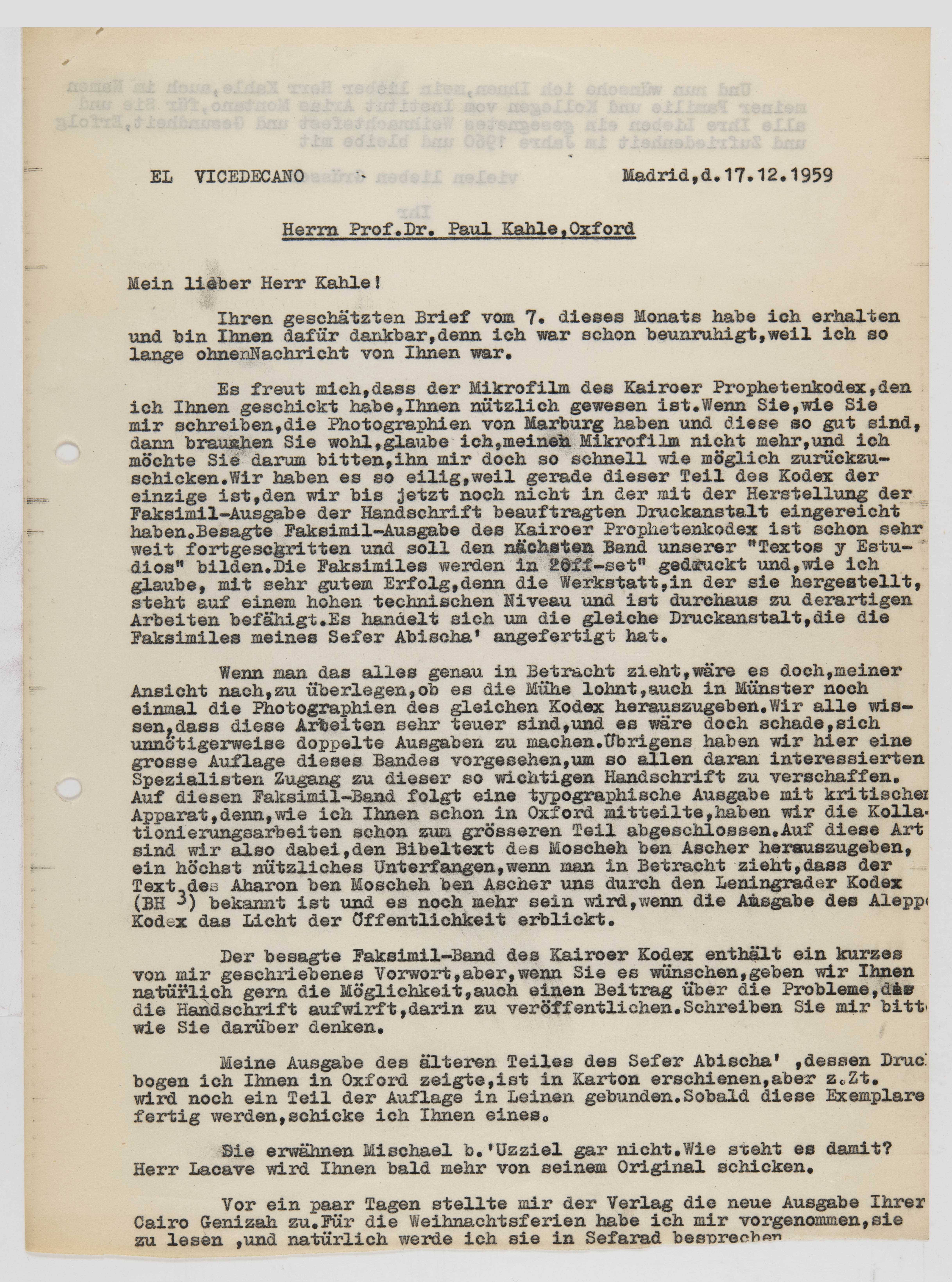
Fig. 2. Pérez Castro's letter
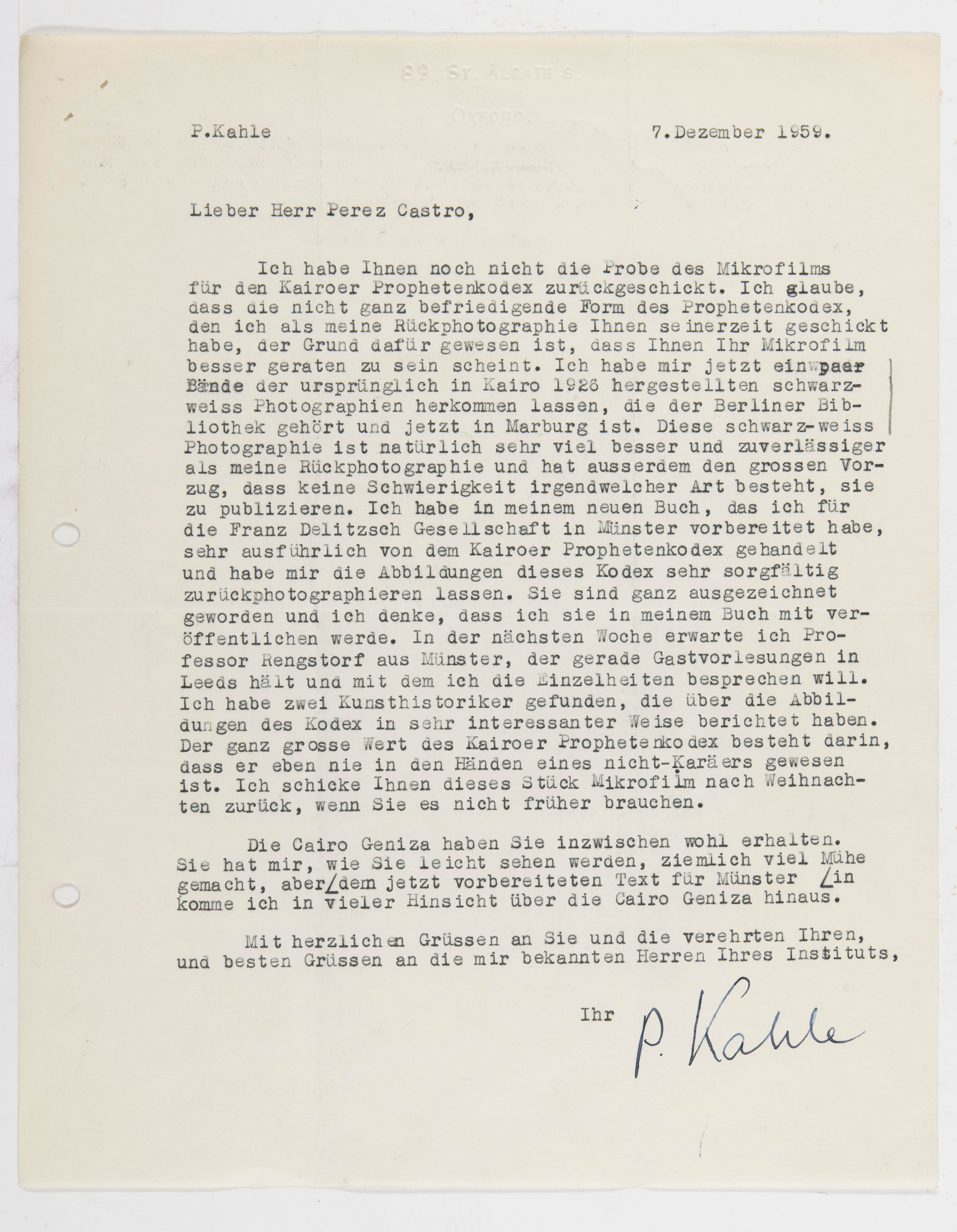
Fig. 1. Kahle's letter
Fig. 2. Pérez Castro's letter
Fig. 1. Kahle's letter
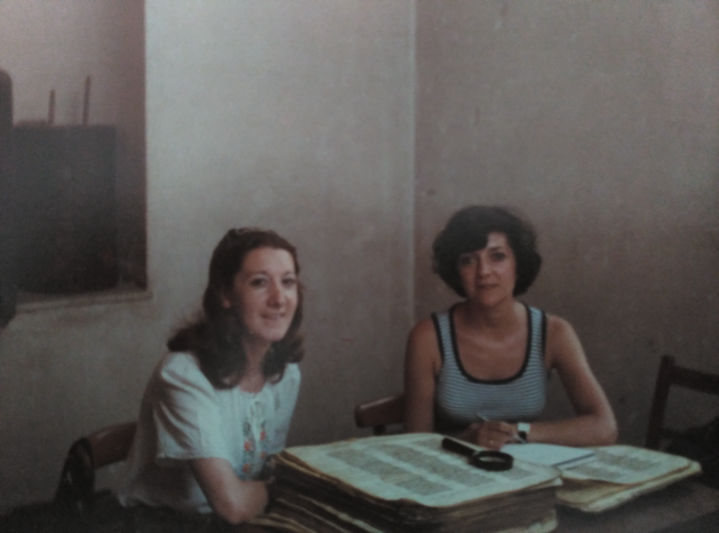
Fig. 3. María Teresa Ortega Monasterio and Emilia Fernández Tejero with the Cairo Codex of the Prophets.
Despite the clarity of these photographs, the editorial team deemed it necessary to examine the original manuscript to resolve ambiguities encountered during the initial collation. Notes from the collation notebooks reveal that most uncertainties concerned vowel and cantillation signs. In some cases, signs such as dagesh and raphe were unclear; in others, the vocalization of entire sentences or paragraphs required verification.
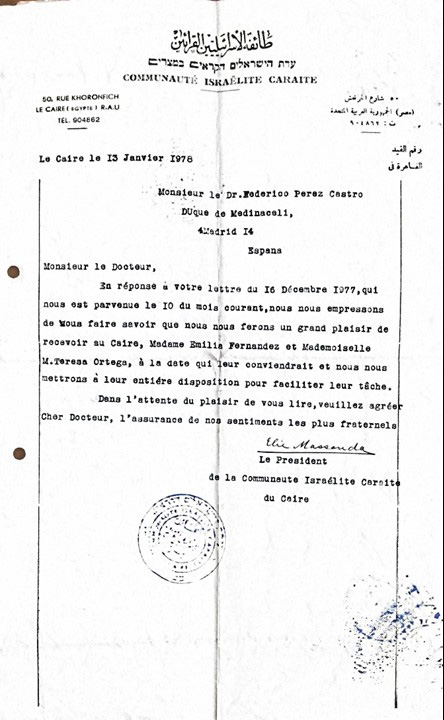
In February 1976, the team began efforts to gain access to the Karaite Synagogue in Cairo, where the codex was housed. After two years of negotiations, they received an official letter of confirmation signed by Mr. Massouda, president of the Karaite community, on January 13, 1978. On May 3, 1978, Prof. Emilia Fernández Tejero and María Teresa Ortega Monasterio traveled to Cairo (Fig. 3). Over three weeks, they worked meticulously on the manuscript, resolving the team’s doubts concerning each book. They recorded every detail of the codex, noting scrapings and erasures, the exact placement of signs, and revising the vocalization of extant portions of the text. Moreover, they examined other manuscripts held in the synagogue, such as Gottheil 14, 17, and 18.”
The publication of El Códice de Profetas de El Cairo spanned nearly two decades, beginning with Tomo VII: Profetas Menores, which appeared in 1979. This first volume also included the Prefacio, a justification of the edition and an explanation of its structure and character. The subsequent volumes were released in the chronological order of the biblical books: Tomo I: Josué–Jueces (1980), Tomo II: Samuel (1983), Tomo III: Reyes (1984), Tomo IV: Isaías (1986), Tomo V: Jeremías (1987), and Tomo VI: Ezequiel (1988), these volumes completed the series of seven volumes dedicated to the biblical text. In 1992, Tomo VIII, an alphabetical index to the Masora parva and Masora magna annotations, was published. Between 1995 and 1997, additional complementary volumes were issued, including analytical indices of the Masora magna and Masora parva, as well as studies on the occurrences of let (‘unique’) cases.
Although the edition is often attributed to Federico Pérez Castro, it was primarily the result of collaborative work. For this reason, Pérez Castro appears in the volumes as director rather than sole author.
The editorial team included:
• Carmen Muñoz Abad
• Emilia Fernández Tejero
• María Teresa Ortega Monasterio
• María Josefa Azcárraga Servert (from Volume II onward)
• Eugenio Carrero Rodríguez (Volumes I and VII)
• Luis-Fernando Girón Blanc (Volume VII)
In addition to their editorial contributions, specific responsibilities were assigned: Emilia Fernández Tejero was responsible for the analytical index of the Masora magna, María Josefa Azcárraga Servert for the analytical index of the Masora parva, and María Teresa Ortega Monasterio was responsible for the index of the let cases.
The edition comprises the biblical text, two apparatuses and explanatory notes (Fig. 4).
The biblical text is reproduced in a single column—rather than the three-column layout of the manuscript—while preserving the division of the parashiyyot (sections of the Torah read publicly in the synagogue). Lines where the last word exceeds or falls short of the established margin are completed with the letter mem (מ). Additionally, the edition reproduces the circellus, a small circle placed over a word or words in the biblical text to indicate an associated annotation in the manuscript’s margins (see Apparatus II).
The first apparatus compiles words with uncertain spellings due to manuscript deterioration or punctuation inconsistencies, providing commentary on these cases. Each lemma is presented only with the punctuation relevant to the discussion.
The second apparatus records the transcription and development of Masora Parva and Masora Magna annotations and identifies the simanim (a selection of one or more words from the affected verses). The Masoretic annotations are reproduced as they appear in the manuscript, except where the indicative period for abbreviations and technical terms is missing; in such cases, it has been supplied.
When both Masora Magna and Masora Parva annotations coincide for the same lemma, the Mara Parva is not reproduced, and the coincidence is indicated by the symbol =. Superscript letters in this apparatus refer to explanatory notes at the bottom of the page, where certain annotations are clarified or expanded.
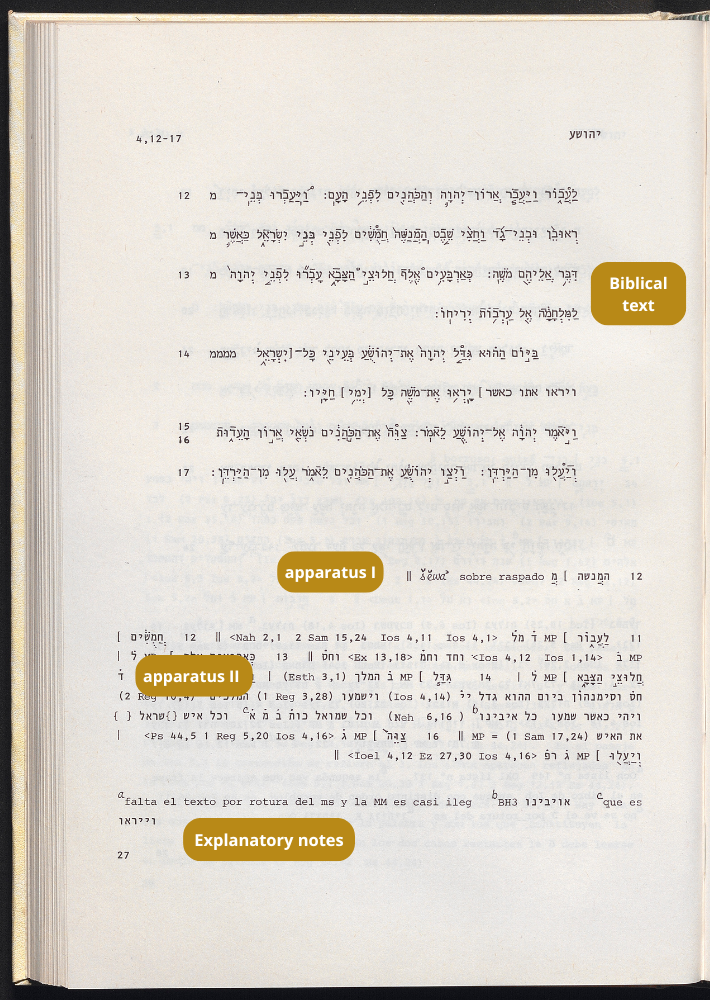
Fig. 4. Page of the edition with the different sections identified.

Fig. 5bis. Deborah's Song in the edition
Another significant, though often overlooked, innovation was the comprehensive indexing of the Masora—a pioneering effort long before the advent of digital search tools. Volume VIII contains an alphabetical index of the Masora Magna and Masora Parva annotations of the Cairo Codex, while two additional volumes provide analytical indexes of both Masoras. These tools revolutionized access to Masoretic annotations, enabling scholars to locate and study every annotated word in the Cairo Codex with unprecedented ease.
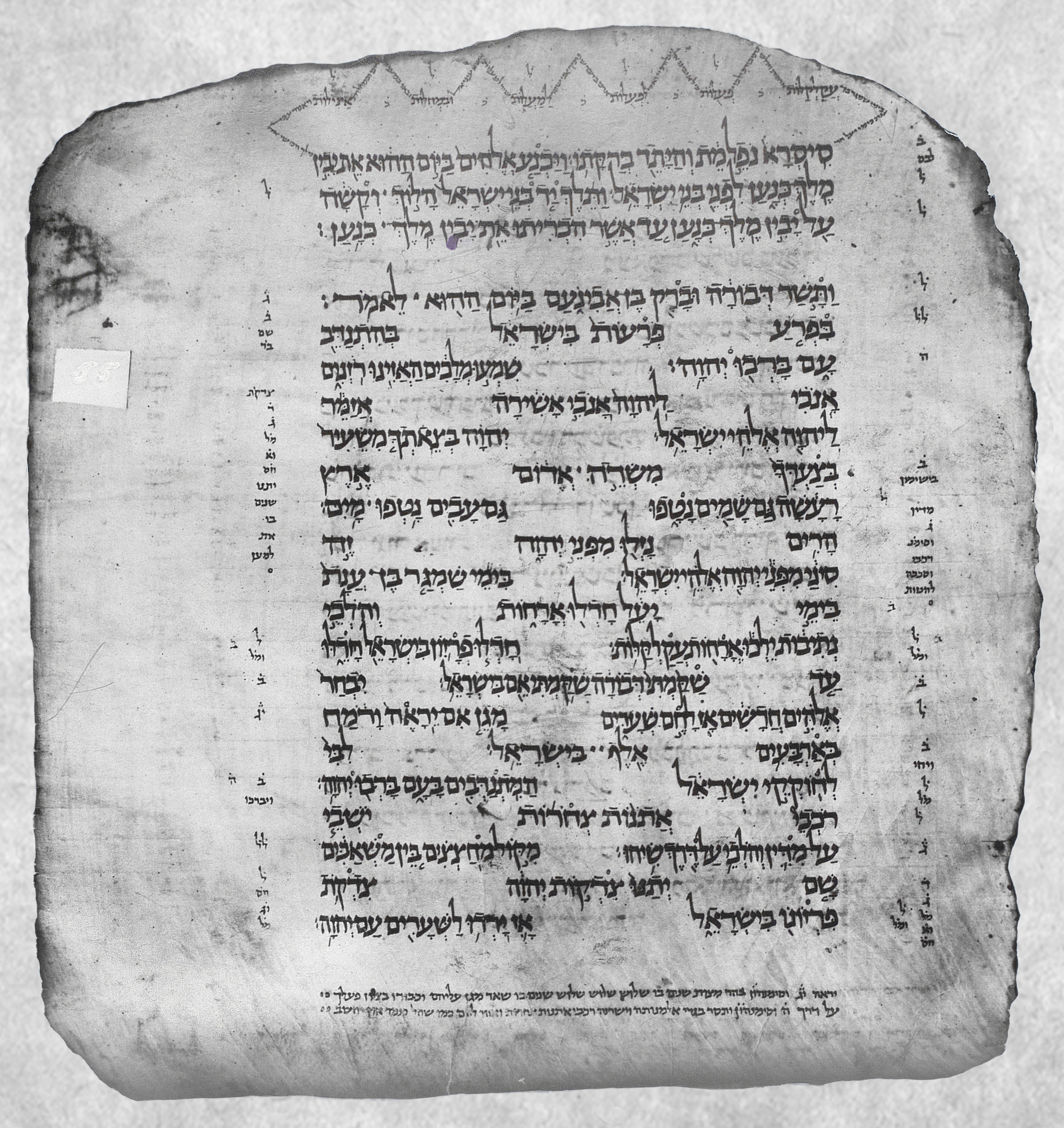
Fig. 5. Deborah’s Song (Judg 5:2-31)
As María Teresa Ortega Monasterio, a member of the editorial team, stated:
Finally, the Cairo edition stands out as a hybrid work—half printed, half manuscript—offering an unparalleled level of precision. Due to the technical limitations of the time, the consonantal text was typewritten, while vowel signs and accents were added manually. This painstaking process ensured an exact reproduction of the manuscript’s palaeographic features, preserving details often lost in critical editions. Among these are: the precise placement of gaʿya, raphe, and meteg signs; the distinctive shapes of accents such as pazer and zarqa; the exact layout of poetic texts, including the Song of Deborah (Judg 5:2–31) (Figs. 5 and 5bis); characteristic ligatures, such as aleph-lamed (Figs. 6 and 6bis); and the unique form of qames in this manuscript—rendered as a horizontal line with a point below (Figs. 7 and 7bis).
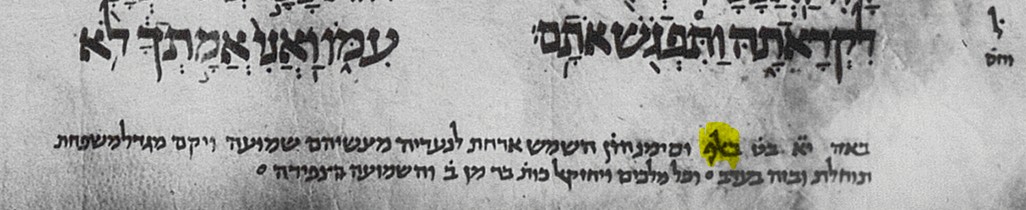
Fig. 6. Aleph-lamed ligature in the manuscript (Mm on 1 Sam 25:19).
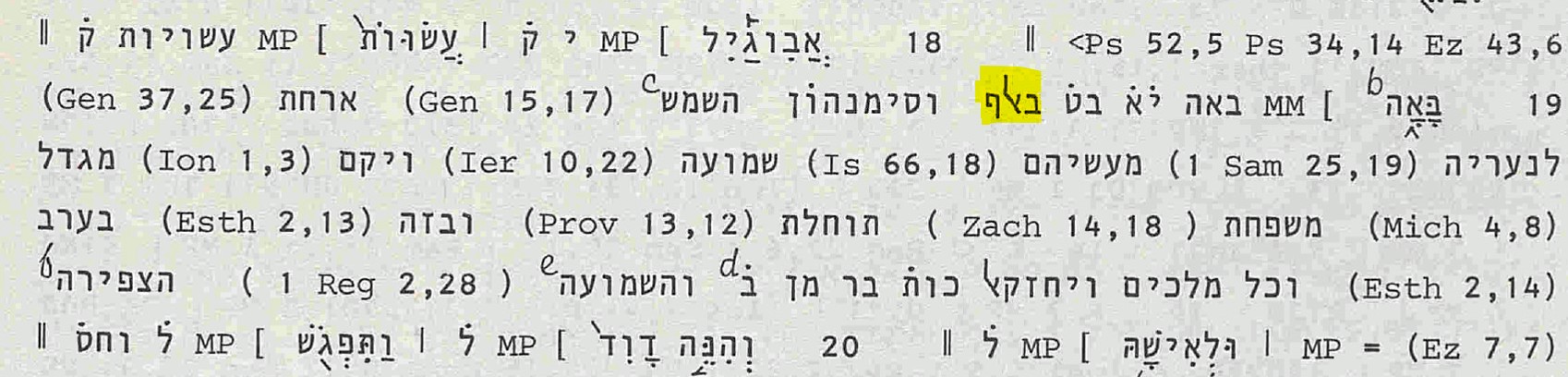
Fig. 6bis. Reproduction of aleph-lamed ligature in the edition.
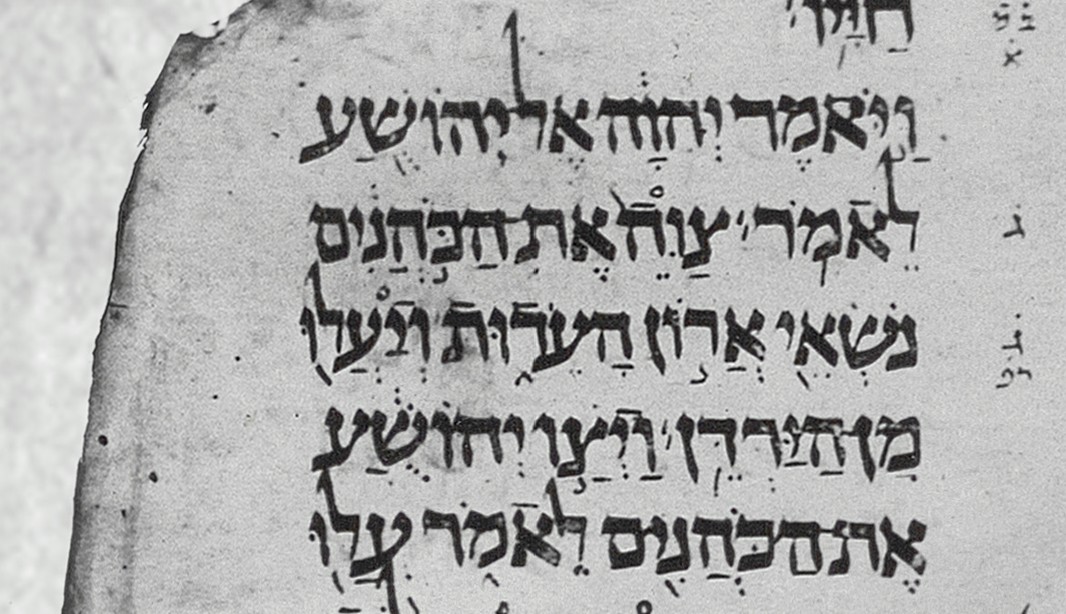
Fig. 7. Portion of the manuscript with characteristic qames (Joshua 4:15–16).

Fig. 7bis. Example of qames in the edition (Joshua 4:15-16).
Described as "a masterpiece of reproduction" (Dotan, “The Cairo Codex,” p. 170), this edition not only preserves the textual integrity of the Cairo Codex but also provides valuable paleographic insights rarely found in other Hebrew Bible editions.
Similarly, Pierre-Maurice Bogaert emphasized the international reputation of the team:
The edition’s scholarly relevance and necessity were also underlined by Emanuel Tov, who noted:
Beyond its importance as a primary resource, the precision and accuracy of the edition have been universally praised:
Dotan further emphasized the groundbreaking nature of this work:
Moreover, Dotan underscored the unparalleled role of the Madrid research team in Masoretic studies:
In short, this edition remains an essential and irreplaceable tool for scholars dedicated to the study of the Hebrew Bible

Recommended citation: Martín-Contreras, Elvira and Biblioteca Tomás Navarro Tomás. The Cairo Codex of the Prophets: digital edition. [online] https://biblioteca.cchs.csic.es/Codice-Profetas-Cairo/ [date of access]