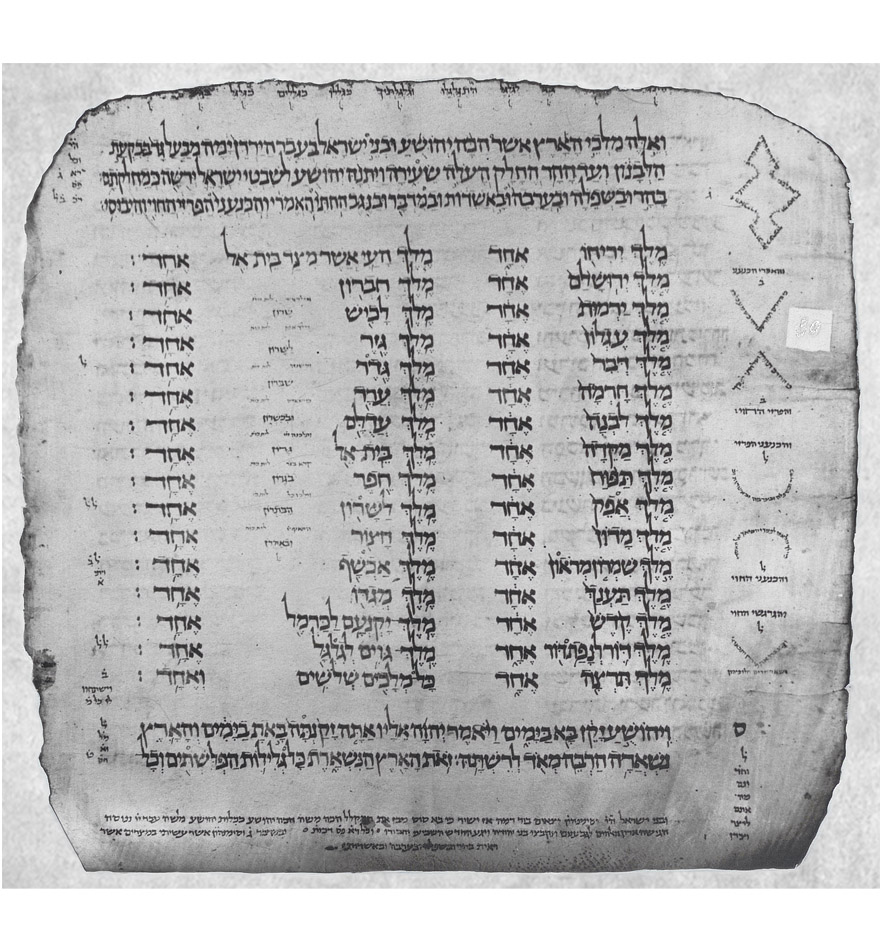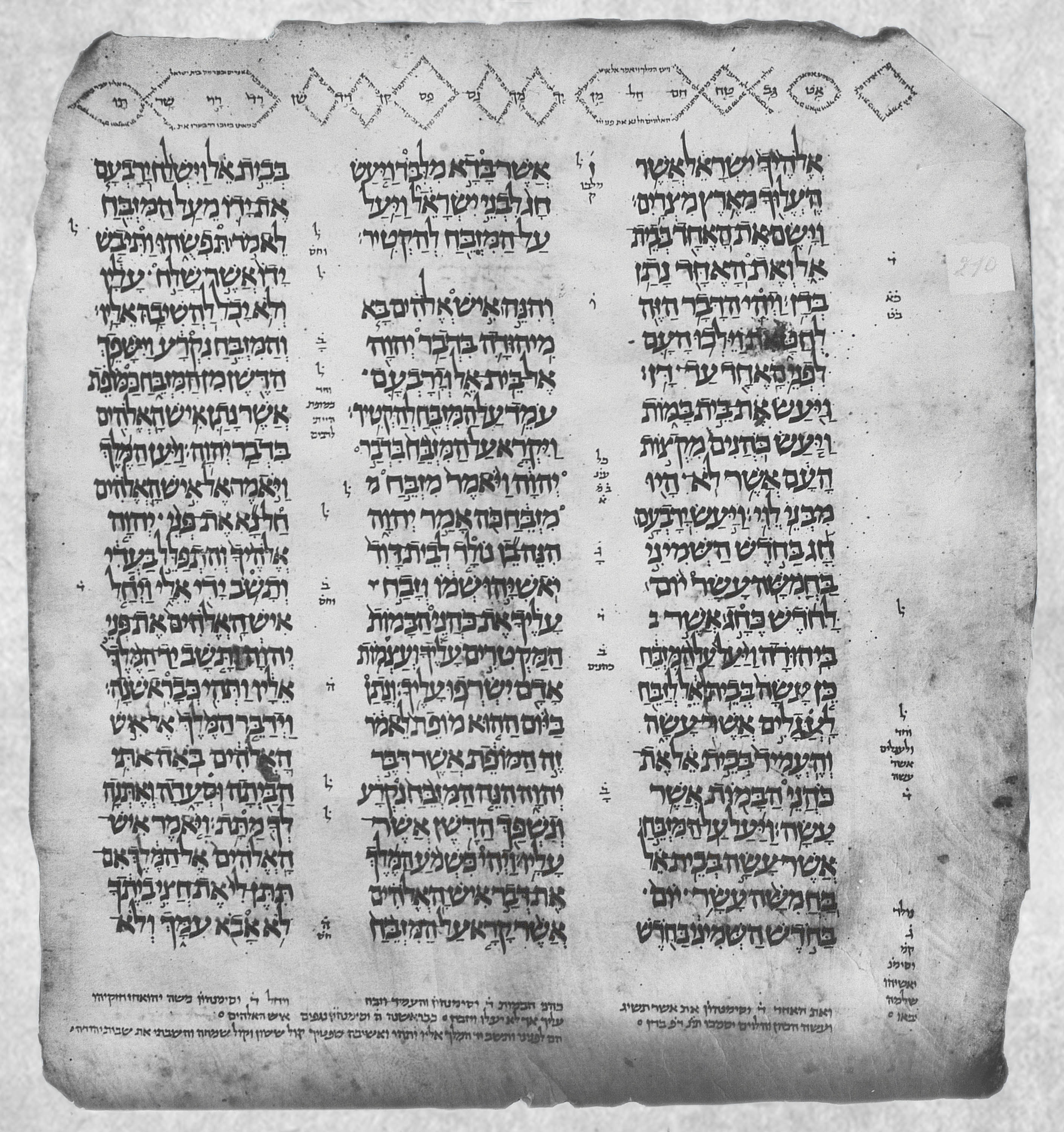
According to its colophon, the Cairo Codex of the Prophets dates from 894/5 and was copied, vocalized, and provided with Masora by Moshe ben Asher in Tiberias. It is written on fine gazelle-skin parchment, with folios measuring 360 × 290 mm.
The textual layout consists of three columns—except for special passages such as the list of kings conquered by the Israelites in Joshua 12 and the Song of Deborah in Judges 5—each column measuring 76 mm in width and containing 23 lines.
The text is executed in oriental square script, using ink that ranges from black to dark brown. It includes vowels, accents, and annotations of Masora Parva (MP) and Masora Magna (MM), some of which are occasionally arranged in geometric patterns.
A distinctive feature is the justification of the left margin of each column by adding a letter or part of a letter at the end of the line. The letters used for this purpose include mem, shin, bet, nun, aleph, and peh, which —except for the last— form part of the scribe’s name: Moshe ben Asher.

The codex comprises the books that make up the Prophets (Nevi’im), the second major division of the Hebrew Bible. The books are divided into Former Prophets: Joshua, Judges, 1–2 Samuel, and 1–2 Kings; and Latter Prophets: Isaiah, Jeremiah, Ezekiel, and the Twelve Minor Prophets (Hosea, Joel, Amos, Obadiah, Jonah, Micah, Nahum, Habakkuk, Zephaniah, Haggai, Zechariah, and Malachi).
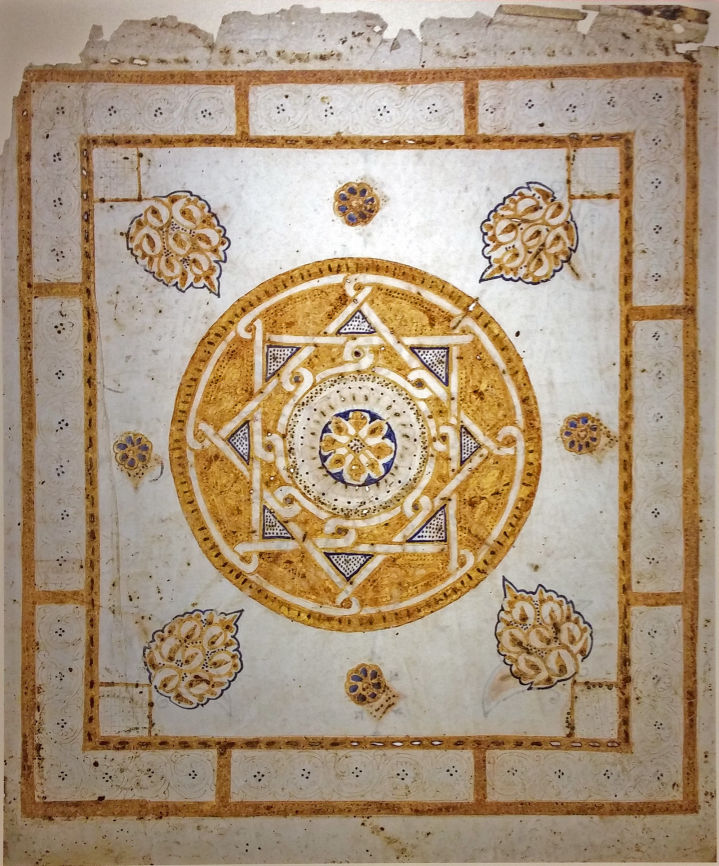
In addition, it contains a list with the number of verses of all the books of the Bible and their middle words, the Seder ha-Mikra or Order of the Scriptures, the list of the rulers of Israel, and the prophets who prophesied during their reigns. It also includes eleven carpet pages executed in gold and colour 1 (Fig. 1). These pages may feature purely decorative motifs or combine ornamentation with text arranged in figurative forms. Most of the text on these pages is similar to the annotations found in the MP and MM.
Finally, alongside the scribe’s colophon that provides the date, the codex contains a second colophon dedicated to the commissioner, Yabez ben Solomon. Several dedication notes appear throughout the manuscript. Unlike the two main colophons—written by the same hand as the biblical text—these later annotations were added by different hands at various times.
For further details, see:
The Cairo Codex of the Prophets occupies a central place in the history of the Hebrew biblical text. It is one of four manuscripts associated with the Ben Asher family, the most prominent Masoretes—responsible for developing systems of vocalization, accentuation, and Masoretic annotation. For this reason, the codex is considered to be of exceptional textual quality and serves as an important witness in critical editions of the Hebrew Bible.
According to the date recorded in its colophon, this manuscript is the earliest dated partial Hebrew illuminated Bible. Although the dating of the colophon has been the subject of scholarly debate 2, even if assigned a later date, it would still rank among the oldest surviving biblical manuscripts.
The Masoretic annotations in this codex exhibit distinctive features that set them apart from those in other biblical manuscripts. These annotations provide valuable insights into the development and evolution of textual traditions, as well as the methods of copying and preserving the Hebrew Bible.
Finally, the geometric arrangements of its Masoretic annotations and the richly decorated carpet pages underscore both their aesthetic and functional significance. They also shed light on the artistic traditions and cultural influences of the period.
Avrin, Pinder Wilson, and Ettinghausen count the number of carpet pages as 13, because they also included pages 581 and 585 in their tally. These two pages have marginal decoration alongside the text but are not carpet pages properly speaking.
Arguments against ancient dating are not conclusive; see Elvira Martín-Contreras, “Confirming what is Written: The Masoretic Term Yafeh” Vetus Testamentum 55 (2018) pp. 606-619, footnote 62.
La fecha del códice está en discusión. Los argumentos en contra de la datación antigua no son concluyentes; ver Elvira Martín-Contreras, “Confirming what is Written: The Masoretic Term Yafeh” Vetus Testamentum 55 (2018) pp. 606-619, footnote 62.
Recommended citation: Martín-Contreras, Elvira and Biblioteca Tomás Navarro Tomás. The Cairo Codex of the Prophets: digital edition. [online] https://biblioteca.cchs.csic.es/Codice-Profetas-Cairo/ [date of access]